The Money Story Project

Articles & Blog Posts 

Co-founders & Money: Patterns, Partnership, Trust - With Nicki Coe
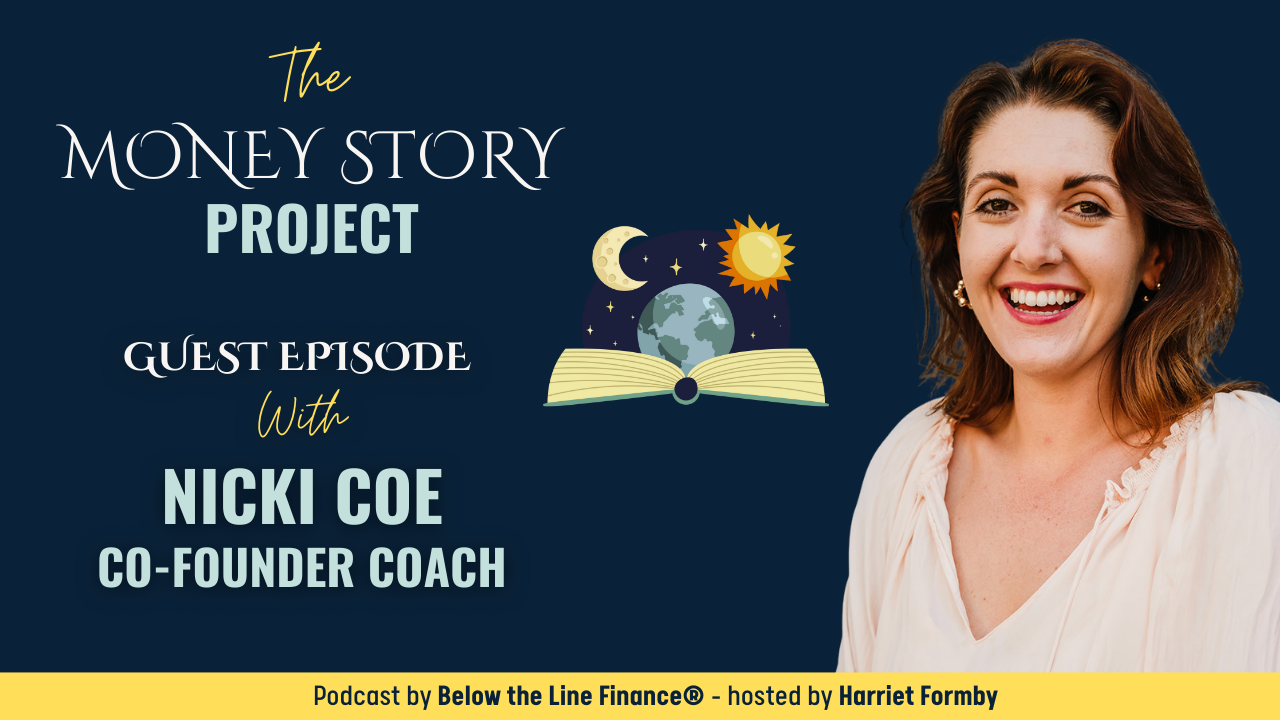
The co-founder dynamic has a way of surfacing everything you thought you'd buried about money.

Themes: money as enabler versus sacrifice · trust shifting through life events · the intensity of co-founding · making money for someone else · fairness and the 50/50 question · when caring too much creates friction · founders having something to prove · the "am I good enough?" question · practical versus personal reflection questions · making financial conversations fun · relational contracting alongside legal · the ripple effect of talking about money openly

"Nothing shines a light on your personal patterns, beliefs, and triggers like being a co-founder." 

That's Nicki Coe — co-founder coach and co-founder of branding agency LUNA + LION. Nicki is on a mission to change the statistic that 65% of startups fail due to co-founder fallout. 

 When I ask Nicki about her money story, she says she hadn't even thought about it until she started a business. Growing up, money was simply there. It meant holidays, experiences, hosting people — it was the thing that allowed her family to make memories together. She saw money as an enabler, not something to question. 

But underneath that comfort, there was also a message being absorbed: making money is hard. It was "almost seen as a bit of a sacrifice" — a trade-off where "to have money you had to almost give a lot of yourself." 

When trust starts to shift 

"Fast forwarding 20 years or so," Nicki says, "my parents got divorced when I was in my mid twenties. And looking back from being a teenager to my mid twenties, I definitely saw my parents' relationship with money shift — and therefore mine." 

Money became something that was used "more of an element of control, potentially." There was fear. A sense that you can make money, but you can also easily lose it. "Almost a sense that money couldn't fully be trusted in some way." 

This was the backdrop against which Nicki left a stable, well-paid corporate job in advertising — at the beginning of a pandemic — to start her own coaching practice. And then, a few months later, to co-found LUNA + LION with her business partner, Scarlett. 

"I definitely found that my beliefs were really tested at that point." 

The intensity of co-founding 

Nicki describes the co-founder dynamic as one of the most revealing experiences a person can have around money. It's personal. It's financial. When you're also friends with your business partner, there's friendship in the mix. Your reputation. Your ego. And money beliefs just add another layer of depth to an already complex situation. 

"I now wish we'd probably had some of these conversations a bit earlier," she says. "You don't know what you don't know." 

What would she do differently? Be far clearer upfront on questions like: How much money do we want to make — and why? What does that money mean to each of us? What does it give us? What are we willing to put into the business to create that money? How do we share it? 

"More about how the money feels, I think, than necessarily what it is on paper."  

The surprise of making money for someone else 

One thing Nicki hadn't anticipated was how motivating it would be to make money for her co-founder as well as herself. 

"You're kind of winning for both of you. You want to create wealth for both of you." 

But that motivation came with pressure too. When things weren't going well — a lost client, a failed pitch — she felt like she'd lost that for her business partner too, not just herself. The responsibility cuts both ways. 

Fairness, friction, and the 50/50 question 

When Nicki and Scarlett started LUNA + LION, they agreed to split everything 50/50. That felt right. They held that model for about three and a half years — including through Scarlett's maternity leave and Nicki's own leave for personal reasons. 

But about 18 months ago, they hit a phase where things needed to shift. They weren't a startup anymore, but they weren't fully established either. The vision needed resetting. The roles needed redefining. And the conversations became intense — not because they didn't care, but precisely because they cared so much. 

"There was such energy there for it to work. It almost creates a pressure for this amazing conversation to happen when it's just actually quite difficult to have." 

Eventually, they moved to a more fluid model — dividing workload upfront for each project and splitting the financial reward accordingly. It's required Nicki to be consistently open about how she feels about money, what she thinks she deserves to be paid, and how to split things fairly. 

"I've never had to be so open with someone about what I think I deserve to get paid on a consistent basis. I'm really proud of how we've got to that point." 


Building the business she needed but couldn't find 

In the midst of those difficult conversations, Nicki went looking for help. She wanted someone who could hold a safe, constructive space and guide the conversation towards an outcome. She looked for a co-founder coach — ideally someone who was or had been a co-founder themselves. 

She couldn't find what she was looking for. 

"It's one of those light bulb moments where you just think — oh my God. Maybe this is what I'm supposed to be doing. Maybe this is me." 

She started interviewing people, doing research, pulling the thread. And the more she looked into it, the more she saw that the support simply wasn't there. Co-founder relationships were breaking down in silence, and no one was talking about it until it was too late. 

"All of those ideas and missions lost. All of those ideas lost because the co-founding teams didn't have the right support — either from the beginning or as they were scaling." 

Is it really about the money? 

I ask Nicki: when co-founders seem to be struggling with financial issues — cashflow worries, paying themselves, how to split things fairly — is it really about the money? Or is there something else underneath? 

"In my experience, it's often both," she says. 

Yes, there are real, material money stresses. If you can't make payroll next week, that's a genuine problem. But what often isn't discussed is what that triggers internally. How do you feel about it? How do you manage it together? 

Nicki observes that there's often something driving founders beyond the practical: "a lot of founders are carrying some sort of belief that they have something to prove. Whether it's to themselves, to a parent, to someone at school, to an old teacher, to whoever." And money is a very black and white way to prove you've made it. 

"When that is questioned or at risk, it brings up those internal fears and worries. Really, the bottom line — I'll speak from my own experience here — is: am I good enough? Am I good enough for this? Am I the right person to do this?" 

Those are questions that go deeper than money. But money is often the fast track to triggering them. 

The conversations co-founders need to have 

So what should co-founders actually be discussing? Nicki breaks it down into practical questions and personal reflection questions — and believes both are essential. 

On the practical side: 

  • How much money do you want to make from this business? Short term, medium term, long term. 
  • How will compensation adjust as roles evolve? 
  • What are your other success metrics beyond money? 
  • How do you handle financial uncertainty — and what's each person's appetite for risk? 
  • What individual financial decisions can each of you make without consulting the other? 

But underneath all of that: 

  • Why do you want the money? 
  • What does it give you? 
  • What does it open up? 
  • What does it mean to you personally? 

She recommends building a rhythm of financial check-ins. Monthly for the day-to-day numbers. Every six to twelve months to review compensation and roles. Annually for the bigger picture — long-term wealth goals, personal vision, expectations. 

"I think there's space to make these conversations fun, creative. Go somewhere outside, a different environment. Don't just sit by the coffee machine. Go and have that meeting where you'd want to have it in five years' time if you've hit those goals." 

Relational and legal 

One of the things Nicki noticed when she started working with co-founders was that the contracts available — whether online templates or through lawyers — didn't cover the relational side of the partnership. They handled the legal and business structures, but not the conversations that actually determine whether a team stays together. 

So she created something that addresses both. A coaching guide covering all the relational things to discuss before you commit to a business together. And a customizable legal template that includes the business legals as well as some of those relational pieces. 

"If you're missing that relational discussion and contracting piece, you're only seeing half the picture." 

The ripple effect 

At the end of our conversation, Nicki reflects on something bigger than business partnerships. 

"Even if co-founders are aware of their money patterns, it's just not something as a society that we are used to discussing. People aren't very open about money." 

But she's seen clients experience a ripple effect. Once they start exploring money conversations more comfortably in the co-founder context, it extends outward — to friends, to family. There's so much value to be unlocked when those conversations become more open, connected, and vulnerable. 

That feels like the real point. Yes, we're talking about co-founder dynamics and business partnerships. But the invitation is wider than that. To look at our own money patterns. To talk about what we're actually working towards, and why. To make space for the messy, human stuff that sits underneath the numbers. 

And maybe even to make it fun. 

About Nicki Coe 

Nicki Coe is a coach for co-founders, on a mission to change the statistic that 65% of startups fail due to co-founder fallout. She gets her clients in sync as a strong team — sharpening communication, resolving tension, and building the right structure so they can grow successfully without friction. Nicki is also a co-founder herself of branding agency LUNA + LION, so she brings firsthand experience as a business partner to her work. 

Connect with Nicki

Free Resource: 10 Essential Money Q's for Every Co-Founder Team — A clear set of questions to align on finances before they create friction, helping you uncover assumptions, build understanding, and clarify expectations at any stage of your business. 

🎧 Listen now — and if this conversation resonates, please follow the podcast and leave a review so more people can find these stories. 


Explore More

Co-founders & Money: Patterns, Partnership, Trust - With Nicki Coe

Value, Systems, Vulnerability: Playing Long Games with Yommy Ojo

Privilege, Poverty & Running a Business with ADHD: A Money Conversa...

Suspicion, Permission & Possibility: A Money Story with Paulina Fol...

Creativity, Resilience & Honouring Energy — with Kirsty Anna Sinclair

Taboos, Power, and Reclaiming Money: A Conversation with MorĂ­n Gli...

Summer Fear, Legacy & Inclusion: Beyond Pricing - with Sumi Fitzgerald

3 MORE Powerful Money Moves for Mission-Led Founders (Part 2)

SUBSCRIBE TO OUR NEWSLETTER

For friendly finance tips, resources and support to help you succeed with your business numbers

Unsubscribe Any time.