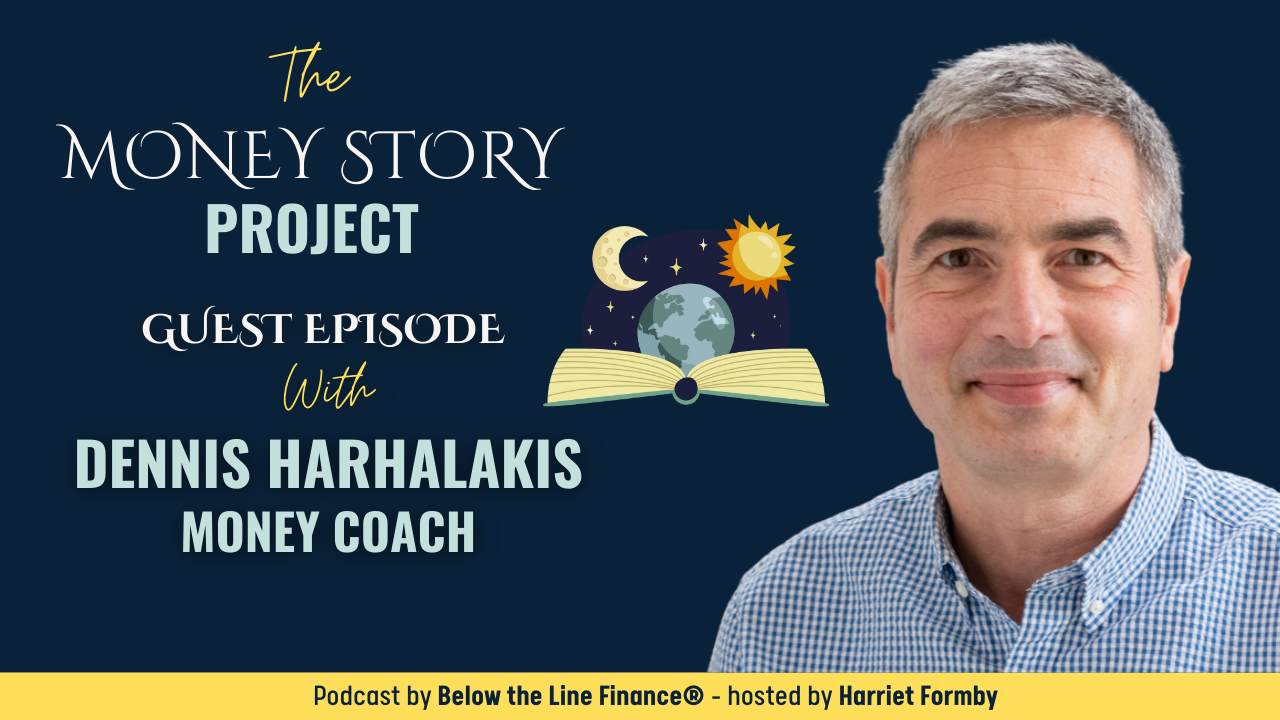
Anxiety, Awareness, Agency - with Dennis Harhalakis
"Finance is numbers. Money is beliefs."
That's the distinction at the heart of everything Dennis Harhalakis teaches. And it's one that took him 30 years in financial services to understand.
Dennis worked in trading rooms. Wealth management. He helped set up a private bank. He knew how the system worked — the products, the investments, the structured deals.
And yet.
When he left that world and the regular pay cheque stopped, something surfaced that no amount of financial expertise could explain. Severe anxiety. A grip around money that logic couldn't loosen.
"It was my father's money anxiety. I'd inherited it from him. I dragged it around the whole of my life."
Themes: inherited anxiety traced back generations · finance is numbers, money is beliefs · working in a bank doesn't make you better with money · the system will use you · wealthy people get mis-sold too · the question that opens everything up · connection before solution · feeling safe with what you have · past, present and future spending · spending problem versus income problem · the biggest investment is in yourself · gripping money so tightly there's no room for anything else · from "don't leave me" to "you're always welcome"
The inheritance we don't choose
Dennis traces his money anxiety back through his family. His father had it. His brother has it. They've traced it back several generations, somewhere into the 1800s.
This is what he now calls "subconscious inheritance" — the patterns, beliefs, and emotional responses we absorb in childhood, without choosing them, without even knowing we've absorbed them.
"All behaviours are learned," he explains. "They all served a purpose. They might not serve you right now, but they all served a purpose and we need to honour them."
A child who spent everything quickly because money was insecure at home? That behaviour made complete sense at the time. Someone might steal it. Someone might ask for it. Better to use it before it disappeared.
But decades later, that same pattern — spend it before it goes — doesn't help you build savings or create a cushion. The behaviour persists long after the original threat has passed.
This is why Dennis starts with compassion.
"If it's not going well for you, you didn't choose it. It's not your fault. You're not in charge of the process. But with awareness, you can be."
Dennis Harhalakis, Money Coach
The question that changes everything
When Dennis works with clients, he asks them a deceptively simple question: How was money talked about when you were growing up?
Not: what were your parents' salaries? Not: did you have enough? Just — how was it talked about?
"If a client says, 'Actually, we never talked about money growing up, it was a taboo subject' — what could be going on for that person?"
Confusion. Unasked questions. A sense that money is dangerous territory, not to be examined too closely.
The follow-up question matters just as much: If you never talked about money growing up, this could be really difficult for you. How are you doing?
Dennis calls this principle "connection before solution." It applies to financial advisors, to coaches, to anyone helping someone with money. Meet people where they are before you try to take them somewhere else.
Two systems, one illusion
One of the most striking things Dennis shares is about the financial services industry itself.
"Just because you work in a bank, you are not any better with money than anyone else. You don't absorb financial literacy through osmosis."
People assume financial advisors are good with money, that accountants are good with money. But financial advisors go bankrupt. Accountants go bankrupt. Working inside the system doesn't protect you from your own relationship with money.
But here's the harder truth: the system itself is designed differently depending on who you are.
Dennis references a newly released book called Fixed by John Y. Campbell and Tarun Ramadorai, which shows how the personal financial services system benefits people who are wealthy and educated — and actively encourages financial mistakes by those who aren't. The title is a deliberate pun: the system is rigged, but it can also be repaired.
"In effect, the industry exploits the mistakes we make, the mental shortcuts we use. It weaponises our own lack of knowledge against us."
The book highlights how cross-subsidies work against ordinary consumers — overdraft fees subsidise free checking, credit card late fees subsidise rewards points, slow mortgage refinancers subsidise lower rates for everyone else. These are systematic transfers from poorer, less educated people to richer, better educated people.
If you don't pay credit card fees or overdraft charges, someone else is. The system runs on inertia, on shame, on people not checking the small print. On the gap between what we should know and what we actually understand.
"If you don't understand the system, it will use you."
But it goes further than that: even wealthy people get mis-sold stuff all the time. Just because someone is wealthy doesn't mean they understand the financial system. The wealth creation process is different from the wealth maintenance process — if you made your money through entrepreneurial activity, you're great at whatever generated your wealth. That doesn't mean you understand personal finance or structured products or investments at all.
It's not about needing more
One of the most profound shifts Dennis describes is realising that his anxiety wasn't about needing more money. It was about not feeling safe with the money he already had.
"More money isn't going to make you feel more safe. Not necessarily. But if you have enough money, you need to feel safe with the money that you have."
It's subtle, but fundamental. The goalposts keeps moving if safety, or self-worth, is tied to accumulation. There's always a next threshold, a next number, a next "then I'll feel okay."
But if safety is about relationship — about how you hold money, not how much you hold — then the work is different. It's internal. It's about patterns, beliefs, inherited anxieties. It's about asking: what would it take to feel okay with what I have? With who I am?
The taboo we don't name
We talk about finance all the time. It's on the news, in the papers, everywhere. Interest rates. Inflation. Tax wrappers. Numbers.
But money — what it means — we don't talk about that.
"We talk about money when it's numbers," Dennis says. "But we don't talk about how money makes us feel."
Money is power, status, control, freedom, belonging, enoughness, self-worth. It's what we absorbed before we had words for it. And that's the vulnerability. That's the taboo. Not the salary, not the debt figure, not the pension pot — but the shame spiral underneath. The "what's wrong with me?" that echoes from childhood.
When someone asks for help with money, they're rarely asking a purely technical question. They might be struggling to receive an inheritance because of grief, or guilt, or complicated family dynamics. They might be terrified of retirement not because of the numbers but because of what it means for their identity.
Connection before solution. Understand what's really being asked before you start solving.
Past, present, future
Dennis offers a simple reframe for thinking about money that cuts through a lot of noise.
Take everything you spend in a month. Call it 100. Now ask: how much is going to the past (debt repayment), how much to the present (living now), and how much to the future (savings, investments)?
If 50% is going to the past, you can see immediately why the present feels squeezed and the future feels impossible. You're stuck in a pattern where your energy is being pulled backwards.
"A lot of people are shamed into thinking they have a spending problem when in fact they have an income problem."
The framework isn't about judgment. It's about seeing what's actually happening — and then deciding what, if anything, you want to change.
And the biggest investment? Dennis is clear on this. It's not the ISA. It's not the pension. It's you.
"The simplest place to start is with your own physical health. That's an investment in yourself that is going to have a multiplier effect."
Your human capital — your energy, your capacity, your wellbeing — is the engine of creation. Everything else flows from there.
If money were a person
I always ask guests this question. Dennis tells me he used to resist it — and then realised why.
"For the whole of my life, if money was a person, I was just hanging onto them so tightly. I wouldn't let them leave the room. I wouldn't let them leave the house."
When you're gripping that hard, there's no room for anything or anyone else. No space for growth, for generosity, for ease.
So what would he say to money now?
"Hi. How you doing? Nice to see you again. Please stay for a while. I'd love you to be my friend. But if you've got to go for a bit, come back another time. You're always welcome."
"My money anxiety won't be triggered when you leave the room."
That's the shift. From grip to relationship. From terror to welcome. From "don't leave me" to "I'll be okay either way."
The journey continues
Dennis is clear that insight doesn't instantly rewire decades of neural patterning.
"You can manifest the way you want to be and light candles and go 'I will be abundant' — but my brain has been wired for 55 years. I need to change that over time."
There will be bad days. Relapses into old anxiety. Situations when I’m tired or otherwise under-resourced. Moments where the grip tightens again.
But the difference now is awareness. The ability to say to the anxious part: Thank you so much. I know you're here to help. But I've got this. I'm all right now.
Self-compassion first. Then change.
Dennis Harhalakis is a Certified Money Coach (CMC)®, founder of Cambridge Money Coaching, and a Money Coach Trainer for the Money Coaching Institute of California. He's on a mission to help people change money from being a source of anxiety, shame, and limitation to a source of energy and empowerment. Dennis works with individuals and couples, runs Financial Wellbeing webinars for employers, and developed 'Money Coaching for Parents' — a unique talk showing parents how to help their children build a healthy and confident relationship with money.
Connect with Dennis:
- Website: cambridgemoneycoaching.uk
- LinkedIn: Dennis Harhalakis
This conversation is part of The Money Story Project — a storytelling space where we explore what money means, what it's meant, and how we're all learning to carry it differently.
Because money is never just about money. It's about who we are, what we've been through, and the systems we live within.
Podcast Spotify Apple Podcasts
🎧 Listen now — and if this conversation resonates, please follow the podcast and leave a review so more people can find these stories.