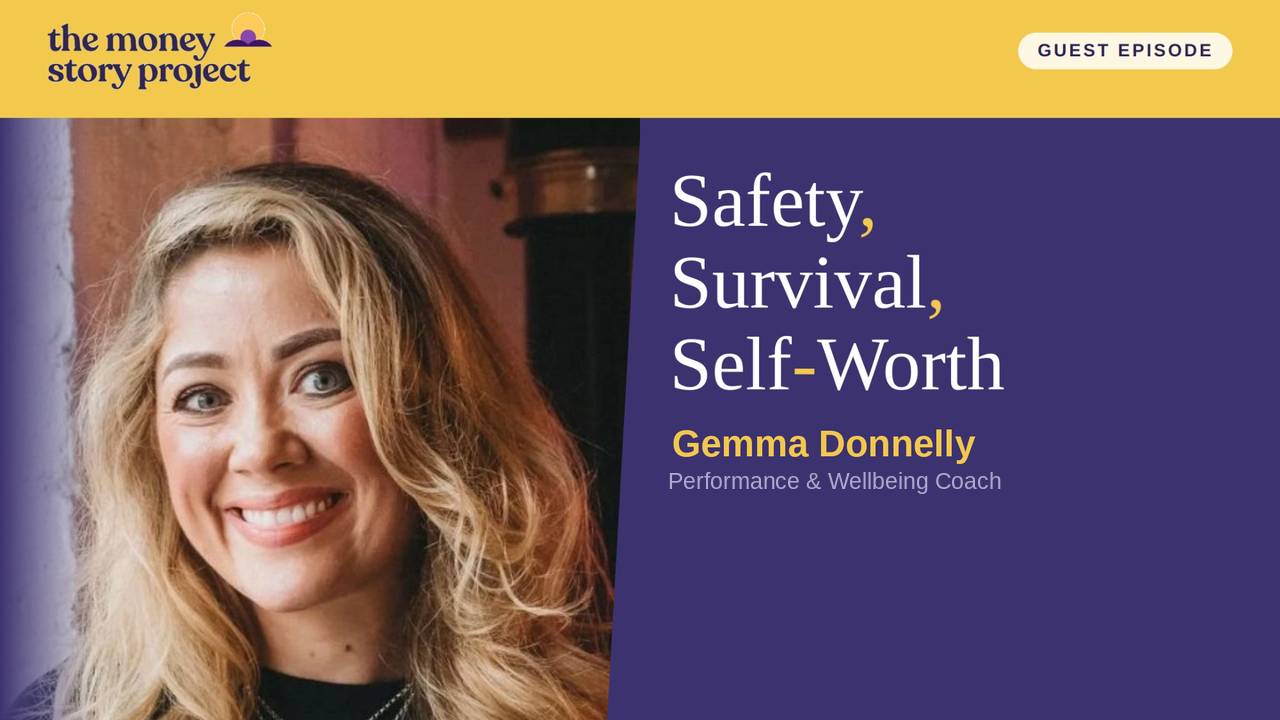
Safety, Survival, Self-Worth: with Gemma Donnelly
Themes: working class roots and work ethic as survival · attaching money to security · net worth is not self-worth · the leap from corporate to self-employment · not being used to having money · spending to get rid of it · nervous system tolerance for uncertainty · why you can't think straight when you're stressed · the prefrontal cortex going offline · financial stress living in the body · jaw tension, lower back pain, and grinding your teeth on holiday · "just rest" isn't helpful advice · productive rest as a bridge · attachment styles and money · avoidant spending, avoidant looking · what do you actually want from life
Performance & Wellbeing Coach, Gemma Donnelly grew up working class, youngest of four, often watching her mum work a few jobs at a time, she understood the meaning of work ethic. She went on to build a career in law, then corporate consultancy, but after experiencing burnout at a young age, behind the scenes she retrained in all the tools and techniques that helped her turn stress & anxiety into calm confidence. Now, six years into running her own coaching business, in this episode, she maps the territory between financial stress and the nervous system - and why the body keeps the score long after the bank balance settles.
The Security Trap
Gemma's money story starts where a lot of money stories start: with watching someone work incredibly hard.
Growing up as the youngest of four children to a single parent, at times Gemma saw her mum juggling multiple jobs. That shaped something deep - a work ethic that later drove her through a legal career and into corporate consultancy, and burnout at a young age. The through-line was security. Money meant safety. Earning well meant feeling secure.
"I attached money with security," she says, "and so I would've been risk averse in my early career. I was opting for safety. But that was an outdated programme laid down years before - and sometimes old programmes need upgrading."
This is what she sees in her clients too. People who are stuck — not because they lack talent or opportunity, but because the part of them that learned to equate safety with a regular paycheque is running the show. They want to make a move, negotiate a rise or charge more. But their mind & nervous system is saying absolutely not - until we upgrade them.
Your Net Worth Is Not Your Self-Worth
One of the things Gemma returns to throughout our conversation is the relationship between money and value — specifically, how hard it is to negotiate a salary, set prices, or ask to be paid properly if you don't believe you're worth it.
"If someone doesn't see the value in themselves, it's very hard for them to negotiate," she says. "Whether that's a salary in an employed position or charging their worth in business."
And then there's the flipside that doesn't get talked about enough: what happens when you do start earning well, but you didn't grow up with money. Some people spend it as fast as it comes in — not because they're irresponsible, but because having money feels unfamiliar. Their baseline is not having. So when they have it, there's an unconscious pull to return to what they know.
"They just feel uncomfortable having it," Gemma explains. "If they're not used to having it they may spend it to get rid of it - because their baseline of comfort is not having."
It's a pattern that mirrors attachment styles in relationships, and one that's almost invisible until someone names it.
The Leap Nobody Prepares You For
The conversation shifts to something both Gemma and I have lived: the transition from corporate employment to self-employment. There's a version of this story that gets told in entrepreneurship circles — the brave leap, the freedom, the fulfilment. But the bit that often gets left out is what happens to your nervous system when the regular paycheque stops.
Gemma is careful to point out that everyone's experience of this is different, and that it depends largely on your existing relationship with uncertainty. If you've always changed jobs, taken risks, moved around — starting a business might feel manageable. But if you've been in the same role or sector for years, the shift can be enormous. And if you've been made redundant and are starting a business not entirely out of choice, you may be building something new while your nervous system is in full survival mode.
"Whenever the rug has been pulled from under you, depending on your nervous system, you can be put into survival mode," she says. "And then you're not going to make the best decision for yourself - you're just responding to that perceived threat."
This is where neuroscience comes in.
When the Brain Goes Offline
Gemma explains something that I think anyone who's ever tried to make a financial decision under stress will recognise: when you're in a heightened state of anxiety, the prefrontal cortex — the part of the brain responsible for logical, creative, long-term thinking — isn't active. You're not choosing. You're surviving.
"We're literally working out of survival," she says. "So if you're in uncertainty, you're not gonna be able to think straight."
The instinct under stress is to rush to make a decision — to get it over with, to resolve the discomfort. But that urgency is itself a symptom of the stress response, not evidence that you need to act right now. The counterintuitive first step, Gemma says, is to do what you need to do to feel safe again. Then you can think.
And not just think logically. You can think creatively. You can hold options. You can ask yourself what you actually want — not just what's going to make the anxiety stop.
"Once you turn that part of the brain back on where the body feels safe," she says, "then you can think: what do you want though? Not just what's the smartest move — but what are your values? What do you care about? How do you want to live your life?"
Where Financial Stress Lives in the Body
One of the most striking parts of our conversation is when Gemma maps where financial uncertainty shows up physically. Not metaphorically. Literally.
Jaw tension. Teeth grinding at night — sometimes you only find out at the dentist. The back of the neck where the head meets the brain stem. Shoulders creeping up. The body narrowing, armoring itself. Lower back pain — instability and uncertainty often lodge there. Chest tightness. Shallow breathing.
"The body is literally trying to protect itself when it feels uncertain and unsafe," she explains. "Any element of uncertainty — financial and otherwise."
And then there's the pattern she describes around holidays. You push through the year, running on stress. You finally stop — and you get ill. The body catches up with you the moment you give it permission to. It's one of the more frustrating expressions of burnout: the first time you rest is the first time you fall apart.

Why "Just Rest" Doesn't Work
This leads us into a conversation about rest that I think is really important — because the advice is always to rest more, slow down, take care of yourself. And Gemma doesn't disagree with that. But she's honest about the fact that for a lot of people, rest doesn't feel safe. It doesn't feel good. It feels like you should be doing something else.
"It's not even about time," she says. "It's about the fact that it doesn't feel safe to stop. If you've been on go, go, go — and you ask someone to stop — it doesn't feel comfortable. It doesn't feel enjoyable. They're thinking about the other thing anyway."
Her approach is to meet people where they are. If stopping entirely isn't possible or doesn't feel safe, what about productive rest? Something that still feels like you're doing something — but that's actually allowing the body to recalibrate. Like breathwork, one of the tools Gemma uses with her clients. With breathwork, it feels like productive rest because you're actively working with the mind and the nervous system — healing the body at a cellular level rather than just scrolling or watching Netflix. For someone whose brain has been trained to believe that time needs to be productive, it's a way in. It's a bridge, not a destination. A way of supporting yourself through a demanding period without pretending you can just switch off on command.
Attachment Styles and Money
Towards the end of our conversation, we get into something I find fascinating: how attachment styles — a framework usually applied to relationships — map onto our relationship with money.
Gemma breaks it down simply. Secure attachment is trusting — trusting yourself, trusting money, trusting that things will be okay. Anxious attachment is uncertainty — checking the bank account obsessively, worrying about what's coming in, never feeling like it's enough. And avoidant attachment is exactly what it sounds like: not looking, not opening the bills, tidying the kitchen instead of sitting down with the budget.
"Are you avoidant in terms of spending money? Asking for money? Putting yourself out there? Making decisions around money?" she asks.
This is something I notice a lot in my own work. Avoidance with money looks a lot like avoidance in relationships — you don't have the difficult conversation. You don't open the door and look, because you don't know what you're going to find there and you don't feel resourced to deal with it. So you distract yourself. You do something else. You'll look at your bank account tomorrow. You'll consolidate those debts next month. You'll work out your investments when things calm down. And as Gemma puts it — you end up doing every other task on the list apart from the one you're avoiding.
It's not laziness. It's not irresponsibility. It's a nervous system that doesn't feel safe enough to sit with the discomfort of looking.
And if you grew up in an environment of lack and haven't updated your internal programming through coaching, having money can feel just as uncomfortable as not having it. You might spend it all to get back to your familiar baseline — the same way someone with avoidant attachment might sabotage closeness because it doesn't feel like home.
It's a reframe that takes money out of the realm of logic and puts it squarely where it belongs: in the territory of emotion, memory, and the body.
What Do You Want, Though?
If there's a single thread that runs through this conversation, it's the distinction between surviving and choosing. Between pushing through and actually being resourced enough to think about what you want.
Gemma's message for anyone listening who recognises themselves in these patterns is gentle but clear: if something has resonated, listen to that. You don't need to change everything — but there might be a way to support yourself better through whatever you're navigating — financially, professionally, personally.
"It's not just about what you're doing practically," she says. "It's about how you're supporting yourself in those times of stress and anxiety and uncertainty — so that you can make decisions without literally living out of survival."
And ultimately, so you can get to the question underneath all of it: what do you actually want from your life?
About Gemma Donnelly
Gemma is an anxiety and confidence coach for busy professionals and business owners. With a background in law and corporate consultancy, she experienced burnout at a young age and retrained in coaching, nervous system regulation, and the mind-body connection. She's been coaching for six years, working with people to build internal safety and capacity so they can make decisions from choice rather than survival.
Gemma helps businesses with wellbeing fuelled performance. She also coaches one-to-one, turning stress & anxiety into Calm Confidence & Clarity. She has 2 spaces opening this month, and is currently creating a new group programme focused on anxiety — working with both the mind and the nervous system.
Connect with Gemma:
Website: coachingwithgemma.co.uk
Instagram: @iamgemmadonnelly
This conversation is part of The Money Story Project — a storytelling space where we explore what money means, what it's meant, and how we're all learning to carry it differently.
Because money is never just about money. It's about who we are, what we've been through, and the systems we live within.
Podcast Spotify Apple Podcasts
🎧 Listen now — and if this conversation resonates, please follow the podcast and leave a review so more people can find these stories.